Which fibres survive the oven
Resistant dextrin is the most heat-tolerant of the common fibre powders. A 2024 review in the Journal of Food Processing and Preservation describes it as having good thermal stability and resistance to heat, acidity and browning. Baking trials back this up. In a 2020 study in Food Chemistry, bread made with resistant dextrin still resisted breakdown by digestive fluid and enzymes after baking, which is the behaviour that makes it count as fibre. The same study found it strengthened the dough and improved crumb quality.
Inulin is more fragile. Researchers note that its breakdown during baking has to be taken into account when it is used in bakery products. In studies that heated inulin directly at temperatures from 135°C to 195°C, the most damaging conditions were 165°C for 30 minutes and 195°C for 15 minutes. Acidic batters, such as those with fruit, buttermilk or yoghurt, add to the risk, because inulin breaks down fastest when heat and acid act together.
Psyllium absorbs water and forms a gel. In baking, that changes the texture and how much liquid a batter or dough needs. It behaves more like a structural ingredient than a background addition.
Any added fibre can affect a dough. A 2026 study in Foods notes that added fibres compete with flour for water and interact with starch and gluten, which is why fibre-enriched doughs often handle differently.
165°C for 30 minutes One of the most damaging conditions for inulin found in direct heating studies. Oven settings for many home bakes are in the same range.
What sugar does that fibre does not
Sugar is a working ingredient in baking, not only a flavour. A 2019 review in Food Research International lists what it contributes beyond sweetness.
- Browning. Sugar drives caramelisation and the Maillard reaction, which give a golden crust and baked flavour.
- Moisture. Sugar attracts and holds water, which affects softness and shelf life.
- Structure. Sugar controls when starch and protein set in the oven, which shapes crumb, volume and, in biscuits, how far the dough spreads.
- Bulk. Sugar is a large share of many recipes by weight, so it contributes body and volume.
Resistant dextrin resists browning, which is useful to a manufacturer who wants a stable ingredient, and means it does not replace sugar's browning. A bake with less sugar in it comes out paler. If you take sugar out of a recipe and put fibre powder in, expect a lighter colour and possibly a firmer texture. That is chemistry, not a failed bake.
Add it, don't just swap it
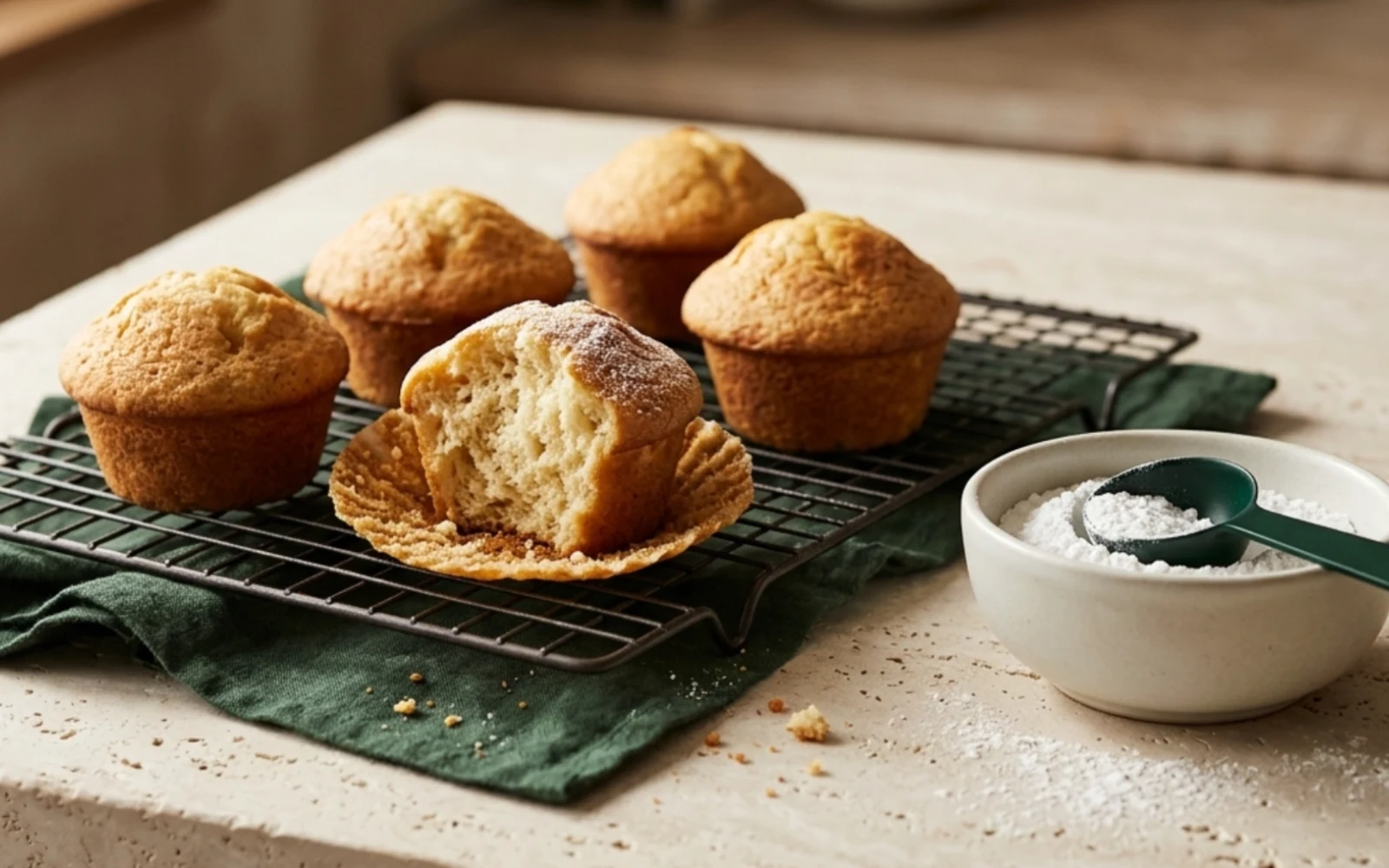
The simplest way to put more fibre into baking is to add fibre powder to a recipe you already know, and change nothing else at first. A few scoops folded into the dry ingredients of a muffin, banana bread or pancake batter will not unbalance a recipe the way removing an ingredient can.
- Mix the powder into the dry ingredients so it spreads evenly.
- If the batter feels stiffer, add a spoonful of liquid.
- Change one thing at a time, so you know what caused any difference.
How much fibre ends up in each slice?
The arithmetic is simple, assuming the fibre survives the bake. Four scoops of a powder that delivers 7 g of fibre each adds 28 g to a batch. Divided across 12 muffins, that is a little over 2 g of added fibre in each one, on top of whatever fibre the flour, oats or fruit already provide.
No one measures the fibre in a home bake, so treat this as an estimate. The fibre that survives oven heat best is the one that makes the estimate most reliable, which is another reason the fibre type matters.
Where DULCI fits
The fibre in DULCI is resistant dextrin, the heat-stable fibre at the top of this page. Each scoop carries 7 g of clinically studied prebiotic fibre, an Excellent Source of Fibre under the Food Standards Code. It dissolves fully in seconds at 85°C, so it works in recipes that call for dissolved sugar as well as in dry mixes. One scoop of DULCI is equivalent to one tea spoon of sugar in sweetness. Worth knowing when adding it to a recipe unchanged.
More on the fibre itself is in what is resistant dextrin? For drinks, see can you put fibre powder in coffee? and does fibre powder dissolve in cold water?