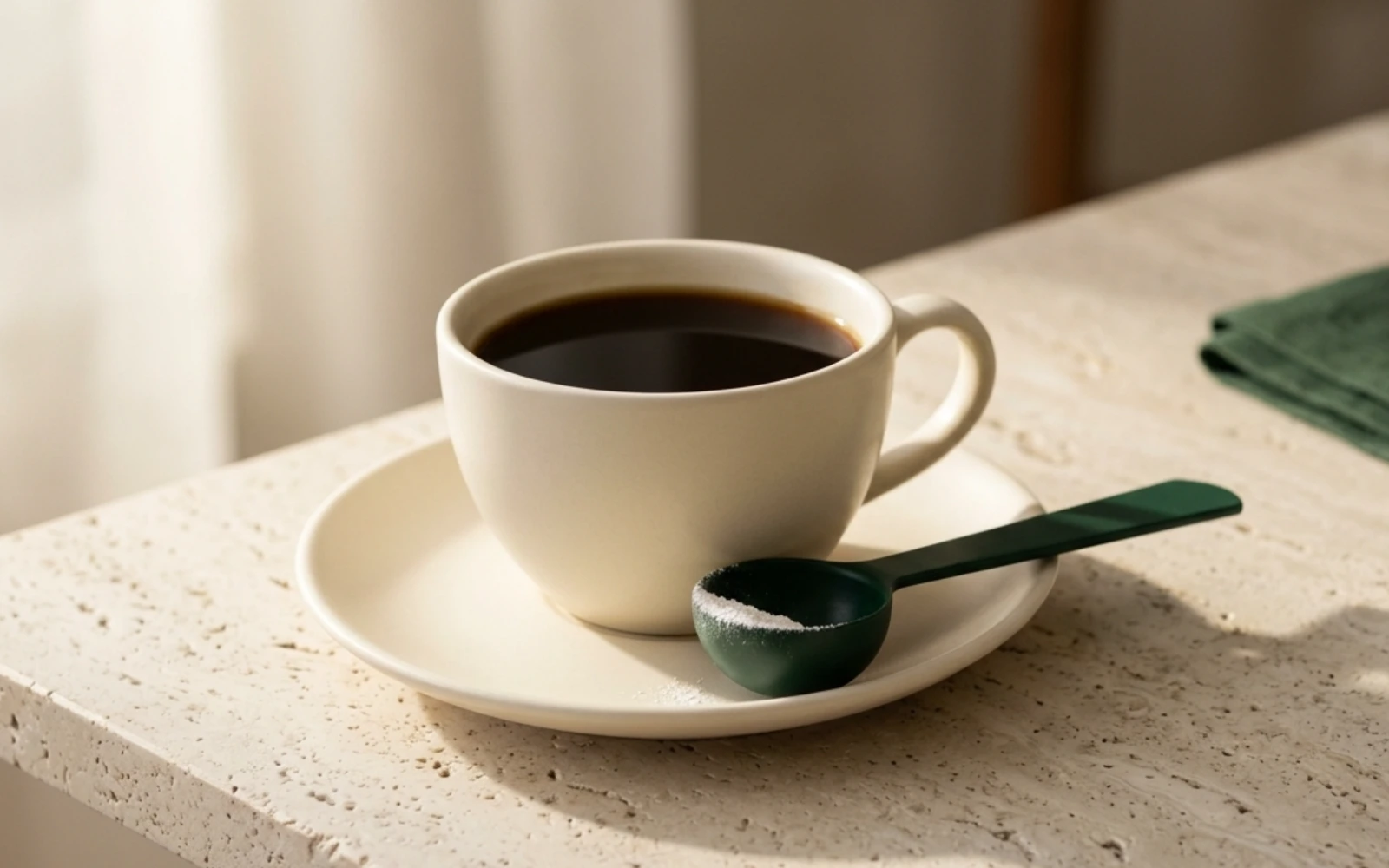
Three fibres, three different cups
Three of the most common fibres in fibre powders behave very differently in a hot drink.
| Fibre | In hot coffee | Texture |
|---|---|---|
| Resistant dextrin | Dissolves | No noticeable change. It has very low viscosity. |
| Inulin | Dissolves well in hot liquid | Little change |
| Psyllium | Absorbs water and swells | Thickens as it sits. It is a gel-forming fibre. |
The difference comes down to viscosity. Psyllium is one of a small group of fibres that form a thick gel in water. Resistant dextrin and inulin are soluble but stay thin. There is more on the gel-forming fibre in what is psyllium?
Does hot coffee destroy the fibre?
For resistant dextrin, no. A 2024 review in the Journal of Food Processing and Preservation describes it as having good thermal stability, and resistance to acidity, heat and browning. That stability is one reason food manufacturers use it in baked goods and drinks.
Inulin is more sensitive, but coffee sits just outside its danger zone. Inulin stays largely intact up to 100°C at neutral pH. What breaks it down is heat combined with acid. Its bonds are vulnerable to acid hydrolysis, particularly at pH 4 and below, and a study of inulin in solution found no degradation at pH 5 and above, even when heated.
Brewed coffee measures between pH 4.85 and 5.10, according to a 2018 study in Scientific Reports. Cold brew came in at almost the same range. That puts coffee just above the range where inulin breaks down quickly, and a cup is hot for minutes, not hours. We found no study that measured inulin in coffee directly, so the honest answer is: little loss is expected, but nobody has checked.
pH 4.85 to 5.10 The measured acidity of hot brewed coffee. Cold brew measured between 4.96 and 5.13.
Psyllium needs more liquid than a coffee cup holds
Psyllium is not just a texture problem. US federal regulations require psyllium products to carry a choking warning, because taken without enough fluid it can swell and block the throat or oesophagus. Product labels direct mixing each dose with at least 8 US fluid ounces of liquid, about 240 mL. A short black does not meet that bar. If psyllium is your fibre, follow the label, and drink it in a full glass of liquid.
How to get it to mix
- Stir the powder into the hot coffee before adding milk. Hot liquid dissolves most soluble fibres faster than cold.
- Add the powder to the liquid while stirring, not the other way round. It is less likely to clump.
- For iced coffee, dissolve the powder in the hot shot first, then add ice and cold milk. There is more on cold drinks in does fibre powder dissolve in cold water?
How much fibre is a scoop worth?
NHMRC sets the Adequate Intake for fibre at 25 g a day for adult women and 30 g for adult men. A powder delivering 7 g a serve covers a little over a quarter of the lower figure. That is a meaningful addition, and it still leaves most of the day's fibre to come from food. How far most Australians sit from those benchmarks is covered in who falls short on fibre in Australia?
Where DULCI fits
The fibre in DULCI is resistant dextrin, so it's a heat-stable, low FODMAP, low-viscosity fibre. Each scoop gives you 7g of clinically studied prebiotic fibre, which makes it an Excellent Source of Fibre under the Food Standards Code, and it dissolves clear in hot drinks. Stevia is added so a scoop can go anywhere a teaspoon of sugar would. More on the fibre itself is in what is resistant dextrin?